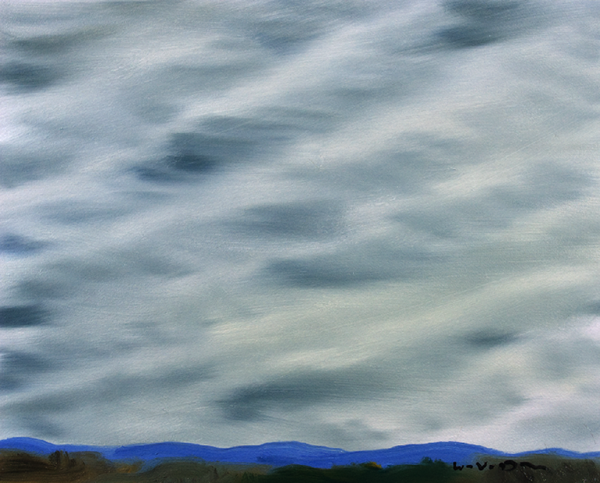
Welcome to The Very Rich Hours, where you can find postings of each day’s sunset. I’ve been painting every sunset since January 1, 2006.


This journal is named for the 15th-century illuminated manuscript The Very Rich Hours of the Duke of Berry (Très Riches Heures du Duc de Berry).


Most of these sunsets are seen from the same vantage point, facing the Blue Ridge, north of Charlottesville, Virginia. Even when I’m traveling and the sunset has to be done later from sketches, all of these works are painted “alla prima” — wet in wet, without later revision or overpainting, in about the same time it takes to watch the sun go down.


Thanks for your interest in this work. To receive each day’s sunset painting in your Facebook timeline, “Like” The Very Rich Hours.


William Van Doren

CONTACT


TABULA ROSA (THE RED SERIES)

VAN DOREN ON THE SUNSET SERIES

READ BEFORE XMAS!

TWEETS ILLUSTRATED

Entries in Stephen Van Doren (9)

Monday
Mar192012

[Whenever I Gaze On] Westminster Sunset – Sunset, Friday, 16 March 2012

William Van Doren, [WHENEVER I GAZE ON] WESTMINSTER SUNSET. Sunset from Westminster, Carroll County, Md. Oil on watercolor block, 13 x 19.

Don’t know when I’ll paint the sunset from Waterloo Station, London, so I went ahead and referenced the ultra-beautiful Kinks song by Ray Davies. Fitting, since just after this I met my brother at a restaurant named Paradiso. (And ... it was a “Friday night”!) If you get a chance, check out the version of “Waterloo Sunset” by Ray Davies and the Crouch End Festival Chorus.

Monday
Mar142011

Back in Baltimore (Sunset, Friday, 11 March 2011)

William Van Doren, BACK IN BALTIMORE (Sunset from St. Paul Street & University Parkway, Baltimore, Md.) Oil on watercolor block, 13 x 19.

From my brother Steve’s room on the eighth floor of Union Memorial Hospital, after his successful back surgery. The view is up University Parkway toward the Johns Hopkins Homewood campus, Marylander apartments at far left.

Tuesday
Nov302010

West of Eden (Sunset, Tuesday, 30 November 2010)

William Van Doren, WEST OF EDEN (Sunset from Rosena, Albemarle County, Va.) Oil on watercolor block, 13 x 19.

Sunset arrived in the rain, in the middle of a three-hour saga involving Laura’s car, a flat tire and a stuck wheel. Thanks to my brother Steve, a shade-tree mechanical genius, for telling me how to free the wheel. (Place my butt down in the pool of water adjacent to the car, put both heels together, kick the sides and the top of the wheel, and it’ll pop right off. After four kicks, I’ll be damned, it popped.)

This all happened at Rosena, a tiny place at the foot of the western side of the Southwest Mountains. During a lull in the action I wandered over to a Virginia historic marker on the roadside and read that Thomas Jefferson considered the Southwest Mountains “the Eden of the United States.” I wouldn’t argue, even while wet and stranded on the slope. 

Friday
Jan292010

Sunset, Friday, 29 January 2010

William Theodore Van Doren. Sunset from Stony Point, Albemarle County, Va. Oil on watercolor block, 16 x 20.

Perhaps a little snow in the offing. 

This was one of those days when water freezes in the ground and makes magic little ice caverns, or castles, underfoot – dense combs of gleaming, finely striated vertical ice crystals, just an inch or two tall, pushing up the red mud.

When I was a kid and encountered these on the walk to school, they seemed amazing. There was that sense of having discovered something new – I mean, really new – had anyone ever seen such a thing? After all, no one had ever said to me, “Listen, someday you’re going to run into these magic ice crystals in the mud – don’t get too excited, we already know about them.”

Quite a few things appeared that way – enormous roots bulging out of a creek bank might have been the most spectacular sight of its kind, for all I knew – and had anyone else ever been to this spot in the woods ... in all of human history? My brother Steve and I would find things like that and, like all great explorers, give them names. An abandoned gravel pit far off in the woods – I’m not sure how we managed to consider an abandoned pit something new, exciting and exclusively ours, but that was Frying Pan Canyon. An arena custom-made for throwing rocks.

Even something new only in the sense that it happened to be in a transient state or condition could feel like a discovery. If a bit of swamp froze over enough to allow a rare game of ice hockey – slapping a pine knot around with broken branches – that day of a frozen swamp qualified as something like an unprecedented and perhaps unrepeatable miracle.

Today by the Rivanna, after this week’s floods, Flint and I walked through large areas of woods that had been under water. Along the banks everything was covered in a heavy layer of silt (marbled with what looked like black sand – topsoil?) and small trees nearest the river were plastered all over their skinny branches with papier-mâché handfuls of leaves, twigs and mud. Flint was excited by the fresh stratum of earth; to a scent hound, it seems when there’s any new covering on the ground – snow, or in this case silt – it’s not so much that a place has changed in one aspect, the geography of scent is so different it’s an entirely new place.

Finding all the changes wrought by the flood, and being the first and perhaps only one to see them, at least here, was like the first time seeing ice in the mud. To be discovering things is very fine.

Thursday
Nov262009

Sunset, Thanksgiving, 26 November 2009

William Theodore Van Doren. Stony Point, Albemarle County, Va. Oil on paper, 16 x 20.

At sunset a few drops of rain began falling on my brother Steve’s face as he napped in the hammock, in two blankets.

Inside, my sister Emily, here from Indiana, told everyone about 350.org.

We called our brother Mike, camping with his family and his father-in-law in Seminole Canyon, in Texas, and left him a raucous Thanksgiving voicemail.

Laura called her sister Mary Scott, who was in Lynchburg, Virginia, with the rest of their family.

My niece Jody missed her fiance, Jason.

My niece Ashley and her husband, Erik, were texting with their friend Dan, anchor on a local newscast, while he was trying to cope with a program cut ever shorter by the Cowboys-Raiders game.

Sandy, my sister-in-law, had just come through a grueling several weeks of medical tests, results of which she and Steve got just yesterday. Thanksgiving was thanksgiving. Sandy did an impersonation of the turkey that gets saved by the White House.

Friday
Nov202009

Sunset, Friday, 20 November 2009

William Theodore Van Doren. Stony Point, Albemarle County, Va. Oil on paper, 16 x 20.

I’m happy the sun came back out for my brother Steve’s 60th birthday.

Rain, earth, sun. That’s more or less the theme from a long walk today, although those three elemental words immediately distracted me by making me think of writing about D.H. Lawrence. Another time. D.H. did loop back around to my brother, whose middle name is Lawrence, but I guarantee Steve wasn’t named for any author.

My college roommate recently wrote, “I was raised to consider myself part of an intellectual elite.” That just goes to show what an interesting culture gap we had to deal with in our early days at Hopkins. Steve and I et al. were raised to consider ourselves ... I have no idea!

Steve’s name was inspired by Steve Van Buren (Stephen W.), a pro football hero whose greatest fame came with the NFL championship games of 1948 and 1949. I don’t think Steve has ever given much consideration to the curious fact that he was named after a running back for the Philadelphia Eagles, of all things – not exactly a well-loved franchise in our experience.

Anyway, even though the Van Doren family, at least, had, in previous generations, a pretty strong tradition of preserving and passing names around, I suspect my parents were part of a (possible?) postwar trend toward naming your kid any damn thing you wanted. I’m the only one who got someone’s name – my grandfather’s – which was his grandfather’s, so break out the roman numerals. I think the story we always heard was that ‘Stephen Lawrence Van Doren’ sounded good.

Sounds very good to me.

Rain, earth, sun. But look, before I get there, I have to ask. My wonderful, many-marvel’d spouse, who is hardly ever wrong – as a consequence of which I now owe her exactly $8700 from all the bets I’ve lost with her – thinks that posts like this one – you know, the ones where it sounds like maybe I got only three hours of sleep and then walked seven miles, so that I go off on the slightest tangent through a lack of inhibitory frontal cortex function – anyway, that people might not like such long posts. What do you think? If you disagree with Laura I will be especially interested in hearing from you. There’s no money involved, unfortunately.

At the first stream we (Flint the foxhound and I) crossed today, I was struck by the effects of yesterday’s storms. The stream banks, where they’re normally a smooth, almost shiny sandy clay, had been beaten down into a flat, matte, finely stippled surface much like the beach after a long steady rain. The water of such a small stream, only yards from the source, is usually quick to rise and just as quick to fall, leaving a clear low current just as before – but today, 12 hours after the rain had ended, the water was still somewhat up and, I was surprised to see, slightly turgid. Dead leaves were pasted to the ground, the trunks of beeches, hollies and poplars looked scrubbed and a clearing sky seemed reflected in the field. 

The rain, in short, had washed the face of the earth. (And even though hundreds if not thousands must have written this before, it feels so accurate to my impression I don’t care.)

Thanks to the wash, we could see along the jeep trail that no hunters had come in today. This meant a lot less uncertainty about what was out there in the 1000+ acres, and less likelihood of “Cold Mountain moments.” That’s what I call creepy, spooky feelings like those the reader gets when Inman is up in the isolated deep mountains and you don’t know if the Home Guard is about to find him. In my case, they can come from not knowing where hunters are or not knowing what Flint may be barking at or chasing, off in the distance.

As for Charles Frazier’s intensely wrought creation – I don’t mean to quibble – it’s not every book that earns a place in one’s vocabulary – but I wouldn’t have minded holding it open to the rain and washing out just a little of the melodrama. In a sense I wanted fewer Cold Mountain moments in Cold Mountain. But that’s me. I’m also crazy enough to wonder, quite seriously, if entire novels might be constructed from rain, earth, sun.